


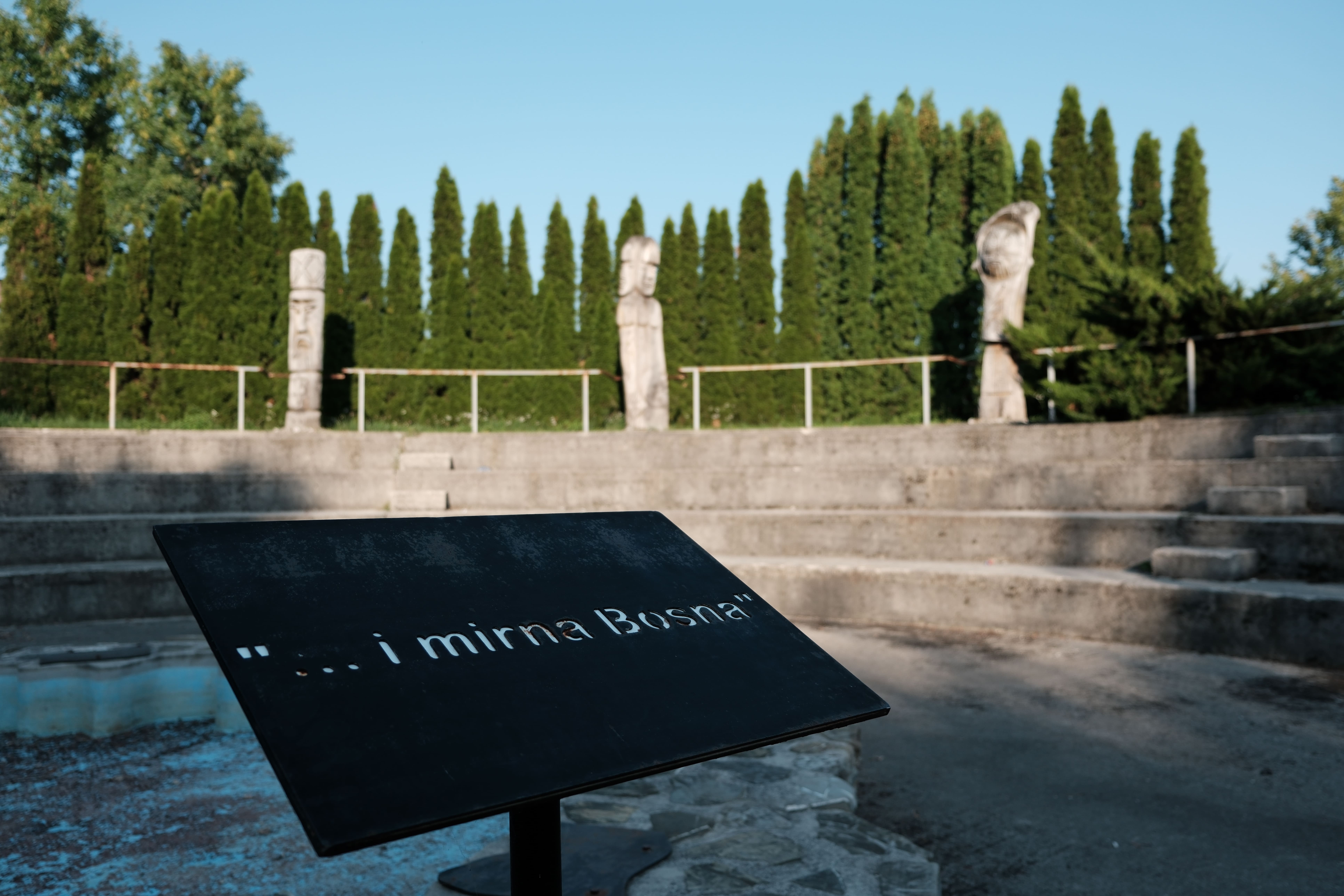
Tara Michelle Gliha, a young psychologist and “State of Peace” Youth Academy’s participant – a program organized by the European Union in Bosnia and Herzegovina in cooperation with the Post-Conflict Research Center last year – writes about memorials created after the war in Bosnia and Herzegovina and how young people should not fall into the trap of imposing ‘truths’.
As part of the Academy’s program, together with 50 other young people from Bosnia and Herzegovina, Montenegro, Croatia and Serbia, I traveled through seven cities in Bosnia and Herzegovina. Our route mainly led to monuments erected after the war in the 1990s. I believe that this field trip is one of the key moments for all young people who want to continue the fight for peace in Bosnia and Herzegovina and the region.
In a time when facts are almost losing their value, when it is increasingly difficult to distinguish lies from truth on the internet, and when we are terrorized by disinformation from all sides, it is important to visit local communities in person. To read for ourselves what is written on monuments, see the names of streets and squares, and to whom those in the immediate vicinity are dedicated. We live in a time of so-called ‘post-truth’, where we have to fight hard and struggle in a sea of overwhelming information to come to our own conclusions, instead of accepting the repeated ‘facts’ and other people’s interpretations that are served to us in schools.
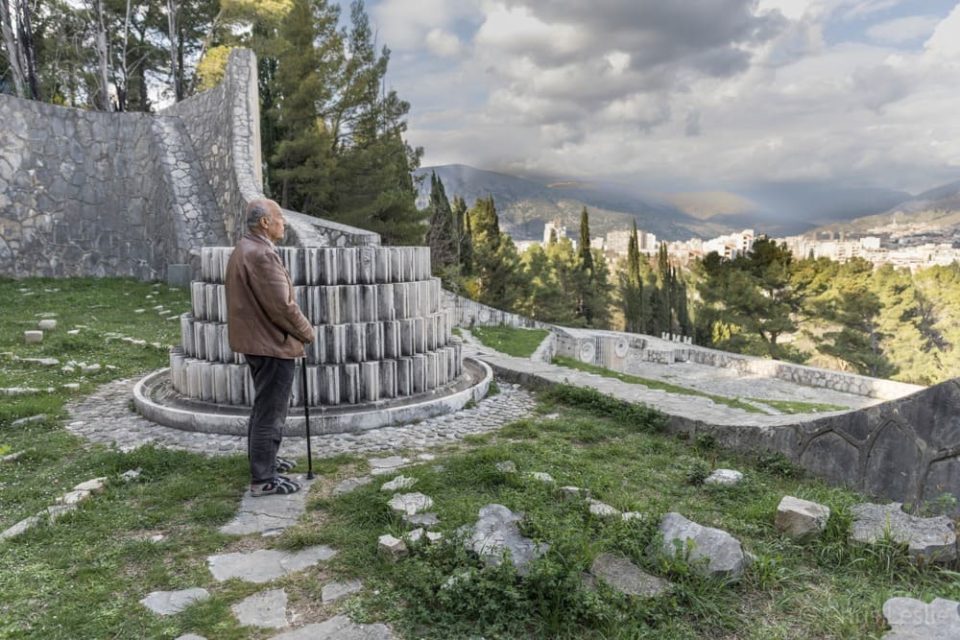
At last year’s Sarajevo Film Festival, a film about the Partisan Cemetery in Mostar premiered, which we – the participants of the Academy – had the honor of seeing a little earlier, at the beginning of August. The Partisan Necropolis is one of the most beautiful and magnificent monuments in Bosnia and Herzegovina, and which many have fallen in love with, including Chris Leslie, the director of the aforementioned documentary. The monument was erected in the 60s to honor those who gave their lives in the National Liberation War. In addition to symbolizing the fight against fascism, the Necropolis served as a place for couples crazy in love, as well as those other fanatics who drew swastikas, broke memorial plaques and burned nearby cypresses. In the last 50 years, the monument has been demolished and rebuilt so many times that it has become a routine. But after the last attack, the renewal seems to have given up. And maybe that’s where the essence of our problem lies: everything we make has a shelf life of five years, and then we start all over. That’s what one activist in Srebrenica recently told me. And that’s not just the fate of the monument; it’s the fate of peace in the Balkans itself. Peace is destroyed, so we build it again. And again. And again. And perhaps it is in that endless loop that the only truth lies, that building peace is our constant obligation, and destruction is our inevitable reality.
Among the anti-fascist monuments, I was particularly impressed by the bust of Enver Šiljak (1919-1942) in the Slana Banja memorial park in Tuzla. In 1941, his name appeared on a warrant issued by the Ustasha government. After he had to part with his girlfriend Frida Laufer, who was also a member of the national liberation movement, he was taken to a public execution, where after the first shot in the shoulder he loudly declared: “Why are your hands shaking, you fascist dogs. Shoot! You can kill Enver Šiljak, but you will never defeat us!”
Enver and Frida were not only anti-fascists but also a famous couple in Tuzla. On the bank of the river Jala there is a bridge dedicated to them, which is unofficially called the ‘Bridge of Love’. Many couples in love put padlocks there, then throw the keys into the river. Frida Laufer, as a Jew, was deported from one camp to another. In Logobrad near Zagreb, she gave birth to a child that she carried with Enver, and later both she and her unnamed child were killed in Jasenovac. Enver Šiljak was declared a national hero, while Frida was officially memorialized only with the ‘Bridge of Love’ in Tuzla. This shows us again and again how women, even when they have made enormous sacrifices for the resistance movement, are often lost in the culture of remembrance in our country. Their individual bravery and suffering are rarely celebrated and often portrayed only through the prism of their male partners or relationships, which largely diminishes the visibility of their contribution and suffering.
For this reason, it is important that young people take a critical look at the culture of memory that surrounds us. Because when we see these monuments for ourselves and read their inscriptions, we can draw our own conclusions about the messages they carry. One of the dilemmas I encountered was when we visited the Osmica monument in Vitez during the Academy, which reads: ‘enemy Muslim grenade’. It is extremely important to separate the perpetrators and the victims, but I fear that with this formulation we are sending a dangerous message and equating an entire nation with the perpetrators of this terrible crime. This specific formulation also points to a broader problem in Bosnia and Herzegovina, which is the identification of ethnic, religious and national identities, although they should be clearly separated.
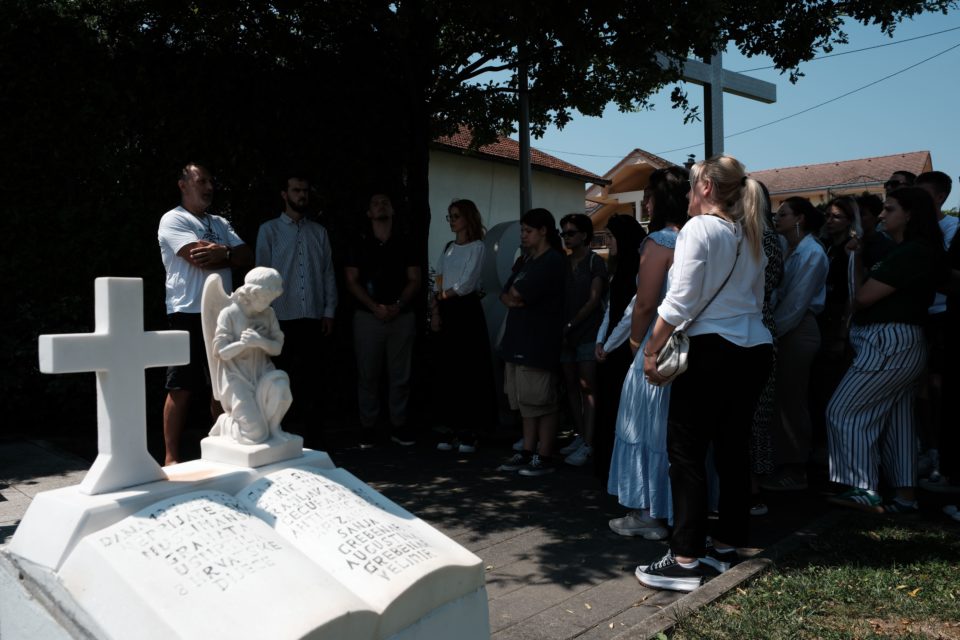
Prejudices and stereotypes in psychology are known to help us keep our own cognitive energy. In our country, when you hear someone’s name, you often automatically place that person in a box. And in regard to that box you already decide how you will treat everything (s)he says, and even whether you will listen to him/her at all. It is understandable and human; even, from a biological point of view, it saves us time and energy.
But at some point this seemingly harmless mechanism becomes life-threatening. In the fight for life, in the fight between living under someone else’s narrative or in the fight of living with our own dignity, each of us has the ability to choose. The only question remains – what do you choose?
Tara-Michelle Gliha is a Bosnian clinical psychology researcher focused on transgenerational trauma, collective memory, and youth mental health in post-conflict societies.