


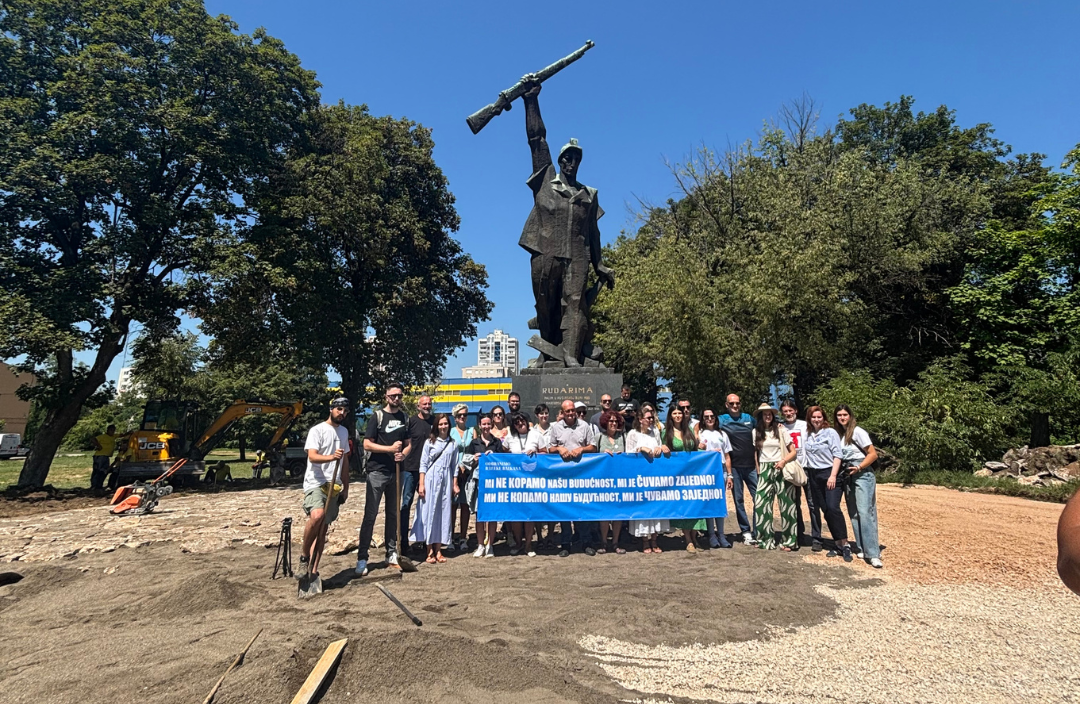
When I was in Tuzla last summer, I discovered by chance that Adi Selman and Nedim Muslić from the organization Cardboard Revolution [Karton Revolucija] were staying in the same hotel. This movement, founded in 2020, is often labeled “radical” or “controversial,” but it ultimately boils down to, in their words, “the fight for air, life, and food.” The struggle for survival is hardly controversial, and yet, looking at the history of our region, almost every fight for freedom has been declared illegal. This is when we start pulling our hair out because what should be the right of every human being is often punished as a criminal act. Nevertheless, Cardboard Revolution has been unrelenting in their struggle for the environment. After a few minutes of talking, Adi invited us to join them in town that night.
We spent the evening together with a large group of activists from all over the region who came to support their Bosnian comrades in demanding that nickel, copper, lithium, and other mineral mines be abolished. A colleague from Montenegro and I asked Adi and Nedim if we could join them at a press conference scheduled for the next morning.
In social psychology, superordinate goals are defined as common, lofty goals that have the power to unite people across nationality, religion, and other identities. This was exactly what we felt on August 8 in Tuzla, as various activists and associations from the region gathered around a common goal, proving that the fight to preserve the country can be stronger than prejudice, discrimination, repression, and even dehumanization.
My colleague and I were in Tuzla with 48 other young people from Bosnia and Herzegovina, Serbia, Croatia, and Montenegro who were also participants in the State of Peace Youth Academy. The academy was held in seven Bosnian cities, including Tuzla. When I asked Adi what advice he had for young people, he told us not to be afraid and not to be merely passive observers in lives that pass by without meaning. Instead, he urged us to give meaning to our lives by finally starting to fight for our dignity.
Fear, in fact, is one of the strongest weapons of any regime: the fear of punishment, condemnation, or stigma. This fear is especially problematic for young people, who grow up hearing the classic Bosnian phrase: Nemoj talasat [Don’t make a fuss]. More than once in my school and university days, I fell victim to those ‘like-minded people:’ we would go together to complain about something unfair that a professor had done, and then I’d turn around at the door of the office to see I was completely alone. Perhaps these school examples seem trivial, as the stakes were not life or death; however, I firmly believe that character building begins in the classroom. Resistance to authority, unjust authority, within institutions is a struggle that will spill over into real life.
A current example of this internal struggle against fear is the story of Pam Hemphill, a former Donald Trump supporter who participated in the storming of the U.S. Capitol on January 6, 2021, and was sentenced to prison. When Trump later offered her a pardon, she refused, sending a letter to the Department of Justice stating that she was not a victim, but a person who knowingly broke the law. In doing so, she directly contradicted the cult narrative in which the leader of a totalitarian regime positions themself as a “pillar of truth” while systematically eliminating or denying all other sources of information to which his followers are exposed. Like any outspoken opponent of the regime, Pam became a victim of the so-called “cancel culture” and today faces a huge amount of threats and intimidation. However, she emphasizes that the cost of lying to herself and ignoring the facts was far greater than anything these people could do to her. Her story is a chilling reminder that living according to someone else’s narrative is not a life worthy of a human being.
Someone once told me a story about a village where one of the sultan’s elephants was loose and on a rampage. The villagers decided to complain to the sultan, but when it came time to do so, they all ran away, except for one brave man. Alone in front of the sultan, he said ultimately suggested that the sultan release another elephant into the village, so that the first elephant wouldn’t be alone.
I have long wondered what lesson I should learn from my own negative experiences. What information and messages is my environment feeding me? To be savvier, or more accurately, more hypocritical, more manipulative, more duplicitous than those who turn their backs? And didn’t the brave villager, in the end, actually turn out to be perhaps even worse than those who betrayed him?
In our society, if you want to pursue any kind of justice, you have to accept the possibility that you will find yourself alone. You may be vilified, convicted, and, if you’re a woman, probably burned at the stake like a witch. At the end of the day, in my opinion, the wise man is not the one who allows himself to be distracted from his original goal, but the one who knows the cost of his decisions and still stands by them.
Author: Tara Michelle Gliha