


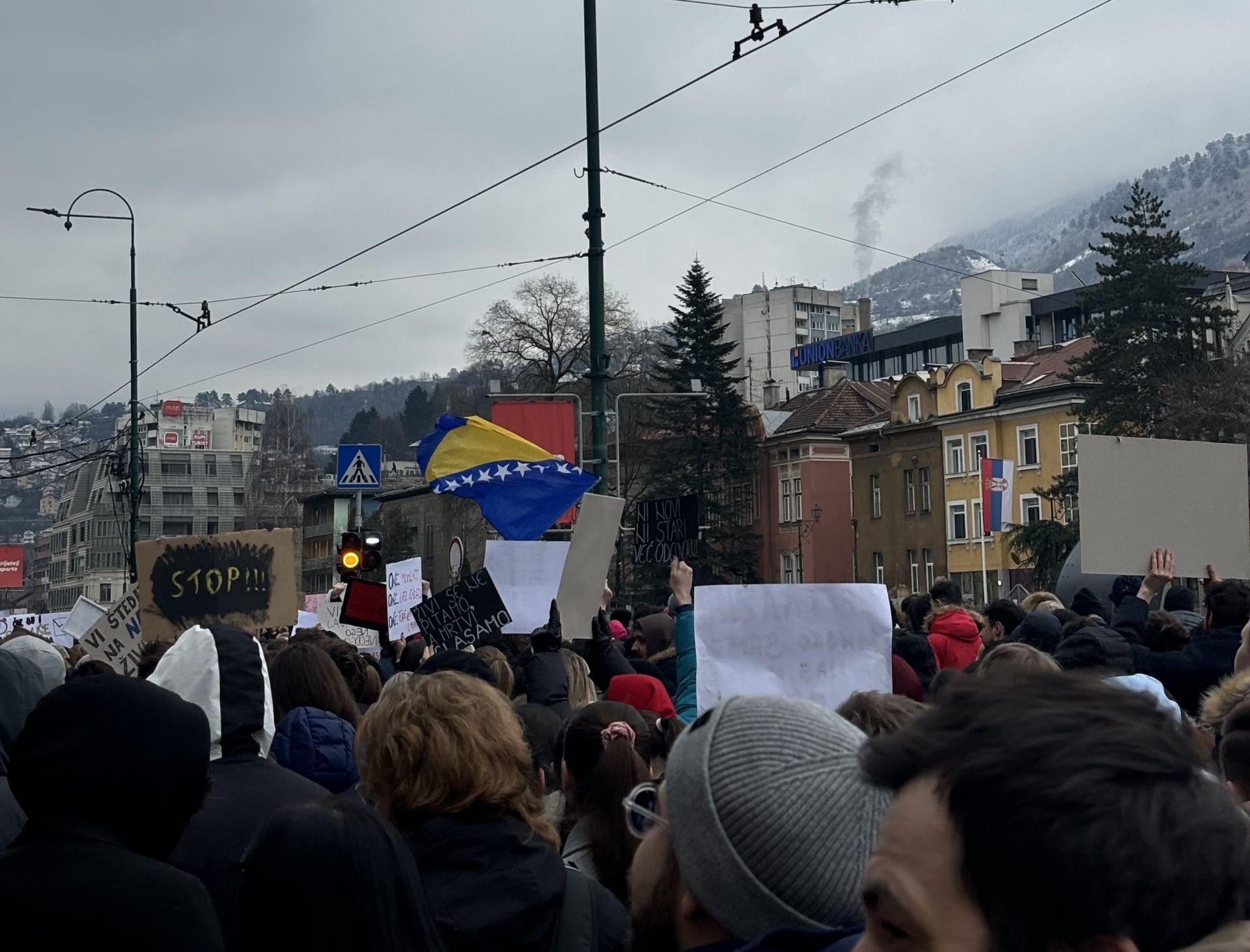
On the first day of protests in Sarajevo, there was an energy akin to what I felt in 2013, when crowds listened to Dubioza and Frenki, as an image of a large pacifier and a middle finger was projected onto the parliament building. After all the horrible events in the past two years—numerous femicides, the Jablanica disaster, the natural gas incident at the Bjelave dormitory, the police officers who sexually abused the little girls from Tuzla, and now the Sarajevo tram tragedy—it’s like something has finally snapped inside the young people of Bosnia and Herzegovina (BiH).
My generation has always seemed quite passive towards any type of political participation. All of our attempts to protest in the streets were fragmented and short-lived. We would get riled up, share some posts on social media, and say it was enough, soon after returning to our everyday lives. Fortunately for us and unfortunately for the victims, people can acquiesce to anything. At some point, however, you realize that it could’ve just as easily been you at that tram station, and that your nearest and dearest would’ve probably gotten used to your absence as well. That’s when it becomes a little harder to just continue with your everyday life.
Young people are often told by older generations that they are lazy and disinterested. But how is it possible that our peers in Serbia are so much more willing and prepared to take to the streets? What is happening to young people in BiH?
Psychiatrist Bessel van der Kolk explains that trauma, when not processed, remains stuck in the body. Furthermore, our parents, who experienced war, remain frozen in that time period. Their nervous system was conditioned to expect danger around the clock, so they learned that staying silent was safer than speaking up. Children born to parents with this type of war trauma are often straitjacketed by very rigid and high expectations. As a result, they are acclimated to very harsh and aggressive reactions to relatively trivial things. To illustrate, you may hear a Balkan mother chastising her child: “What do you mean you got a B in math? I’m going to have a nervous breakdown because of you!” Trauma is not like the flu, it doesn’t just go away. It has to be worked through in therapy. And how many people who have experienced the war have actually tried to do the work?
“Be careful, they’ll hold it against you.”
“Be quiet.”
“Don’t rock the boat.”
That is what young people are constantly told. If someone continuously keeps feeding you a certain type of information, even if it’s a lie, it will become your truth. Moreover, young people are jaded by a system which is fragmented, murky, and complex. BiH institutions are so decentralized that it is very difficult to bring any good idea to fruition. When we take a look at everything we have been taught, and all that we have inherited, is it really that strange that we are so passive and disinterested?
So, why have protests erupted now? Why weren’t we taking to the streets when Nizama Hećimović was murdered in Gradačac in 2023? Why didn’t we demand an open investigation regarding the Jablanica disaster? Why did we settle for a cover-up?
Part of the answer lies in the fact that people have simply reached their breaking point. All the collective anger that has been simmering just beneath the surface for years has finally surfaced. However, part of the answer is also rippling in from the region. The wave of civil disobedience from Belgrade has finally reached Sarajevo. Although we’d all like to believe we’re immune to trends, even protests are not exempt from the pull of social media dynamics. Rebellion today has its own aesthetic. It comes with a frame, a slogan, and a microphone. We all want to be part of the snapshot that will last forever. But if a protest can become a performance, this idealized vision of a group of young people finally awakening from their political coma to change the world starts to wither away.
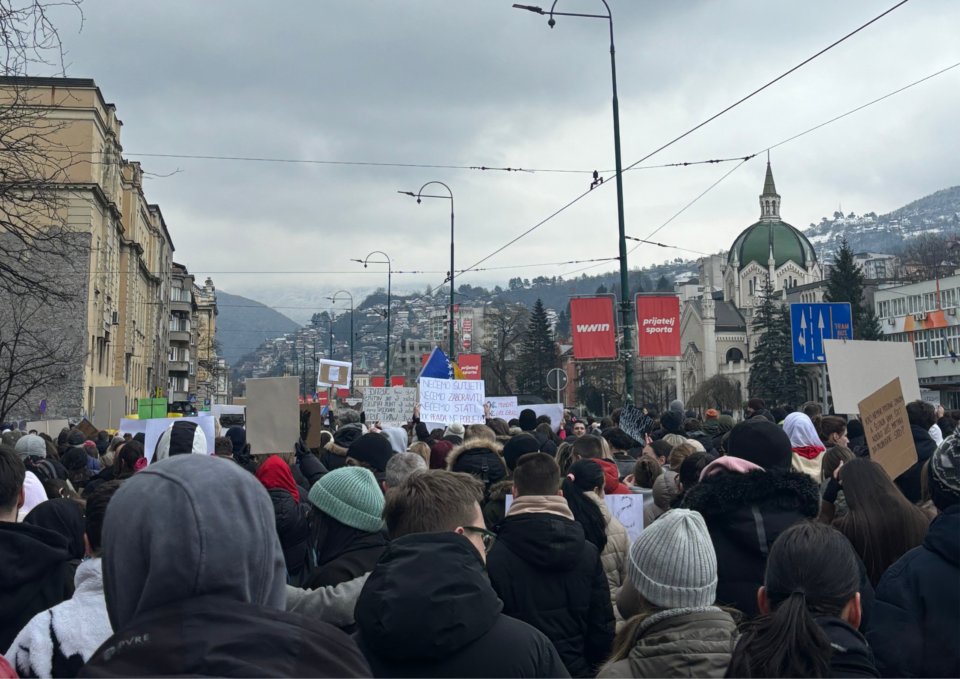
Most people have trouble accepting that two opposing things can be true at once. One can support the fundamental intention behind the protests but disagree with certain occurrences one witnesses there. At a certain point, we have to ask ourselves: have we gone too far?
At every mass movement, there will be people whose values don’t align with our own, even though, on the surface, we appear to be fighting for the same cause. Moreover, even when such movements are triggered by justifiable outrage, they have a very dangerous characteristic: they can easily become radicalized. The euphoric mania that spreads through large groups can easily overshadow any individual sense of personal responsibility. Angrily marching through the streets is one thing. Intentionally damaging parked cars or stopping a mother from driving her child to school is another.
In the fever of a crowd, it’s very tempting to succumb to extreme ideas and conclusions. Extremes are alluring because they’re so simple and comforting: Our country is collapsing. All politicians are thieves. The government is plotting to kill us all. The truth, however, carries a far heavier burden. Not all politicians are the same. It’s not solely the government’s fault that we’re in this predicament. How many of the people marching in the streets today actually voted in the last election?
When anger isn’t recognized for what it truly is—a side-effect of deeper and more difficult emotions like sadness—and when it’s not channeled in a responsible and mature way, it culminates in extremism. It transforms into bloodthirsty rhetoric and cruel actions. At that point, we are no longer fighting for justice but projecting our own frustrations at the cost of punishing the wrong people.
Amid these social dynamics, one will inevitably bear witness to a certain hypocrisy cloaked in the guise of empathy and compassion, and people who speak of justice and grandiose ideas but incite violence wherever they go.
Existing in nuances is exhausting. It’s much easier to view the world in black-and-white. Consider the way we treat public figures: one day we idolize them, the next we tear them down. Reality is almost always somewhere in between. We can’t know everything and most of the things we hear and read are not completely true.
These protests have shown us that we can’t just decide to wake up and change the world. It takes true dedication, time, experience, and perseverance. Protests can easily become a platform for self-promotion and manipulation. If we want real change, we need to know how the system functions—who is responsible for what, and where real political pressure is exerted.
If we’ve already decided to take to the streets, we can’t turn our back on violent incidents that we don’t agree with. We mustn’t allow ourselves to be politically exploited by either those in power or the opposition. During the protests themselves, we must continuously educate ourselves, verify the information we share, and refuse to participate in spreading disinformation without our knowledge.
Otherwise, this will all become yet another black-and-white wave of bitterness. It will eventually dwindle, and we will again, eventually, simply return to living our everyday lives.