


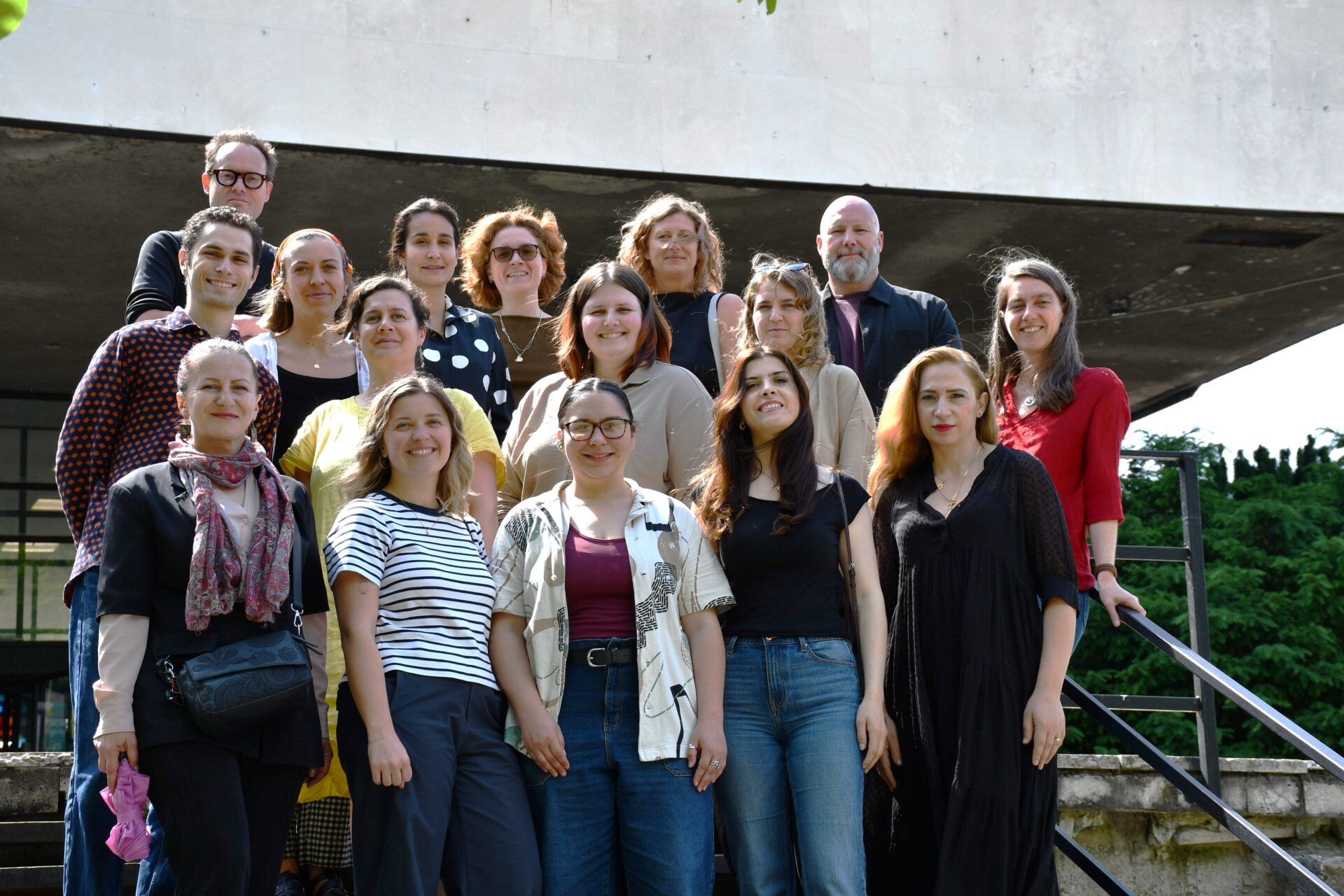
The Post-Conflict Research Center, as part of COST network’s PEACE research community (Peace Research Community Europe), hosted the workshop ‘Local Peace: Arts-Based Practices.’ This event is part of the local peace working group, led by Velma Šarić, Founder and President of the Post-Conflict Research Center, and Dr. Maarten Van Alstein, Senior Researcher at the Flemish Peace Institute. The workshop, chaired by PCRC’s Tatjana Milovanović was held at the History Museum of Bosnia and Herzegovina on May 27 and 28, 2026. This workshop was conducted in collaboration with Ilaria Tucci (Tampere University), Cindy Horst (Peace Research Institute Oslo, PRIO), and Tiffany Fairey (King’s College London). Ten participants, including PCRC fellows Nicolas Pantelick and Adysen Moylan, joined researchers and practitioners working at the intersection of education, peace and conflict research, and the arts.
The Workshops
Over two days, participants engaged in facilitations, discussions, and activities exploring embodied practices, such as Ilaria Tucci’s application of theater as a method for transforming conflict. They considered questions posed by Tiffany Fairey of King’s College London, including “what might a photography of peace consist of,” following Fairey’s presentation on participatory, photography-based peacebuilding work in communities affected by violence around the world. Her research was developed from the recognition that photographs of war and violence are often elevated, leaving ambiguity in how one might “capture” peace. Finally, the PCRC also hosted a panel on education, arts-based practices, and local peace featuring Nic Pantelick (PCRC’s Harvard Fellow), Đuldina Kurtović (professor of philosophy and aesthetics), Ljiljana Siničković (ProPeace Western Balkans), and Tatjana Milovanović (PCRC).
An overarching theme over the course of the two days was how this research community might act as a bridge, legitimizing arts-based approaches, which are often undervalued in academia and in policy and practice as well. One challenge posed was how artistic methods might be used to develop, analyze, and disseminate research in tandem, not siloed. The workshop facilitators recognized how the “local” and arts-based methods are applicable to generating change at the highest levels of society, including exploring actionable steps for policy integration following the workshop.
Research Presented
The working group members presented on a range of topics, including Larissa Fuhrmann’s (Peace Research Institute Frankfurt) work, ‘Deconstructed Bodies in Search of Home’, a curated exhibition co-created with Sudanese artists. Larissa’s work was moving because, rather than using arts-based methods for practitioners to build peace, it clearly showed an approach that collaborated with what had emerged organically and “from within” Sudanese society, as activists, survivors, and artists from violence-affected communities employed art to transform violence.
Dilara Kina (Hacettepe University / Ministry of National Education) shared insights into her work at the intersection of social-emotional learning and storytelling with Kurdish-speaking families in Turkey. Charles Warner, a social anthropologist (University of Leuven), discussed the use of arts-based methods with veterans in ‘Art, Peace, and the Practices of Representation,’ focusing on his work with veterans in the Western Balkans. Uliana Furiv (University of Utrecht) introduced the Ukrainian initiated UAx Platform, supporting artists, higher education, and building community even in conflict zones, with her practitioner based research. Finally, Nina Silva (University of Louvain) presented ‘Territory as Victim: Mapping the Impact of Warfare on Indigenous Territories,’ which examined the expansion of reparations beyond narrower or individualistic legal frameworks to recognize territory itself as a victim of armed conflict. Additionally, her work used music as a research tool, such as in legal evidence for the community’s testimony. Finally, it demonstrated that participatory methods based on indigenous knowledge, even when employing ‘colonial tools’ such as maps, can not only transform reparations but also address structural violence. She described Colombia as ‘a laboratory for Transitional Justice.’ This approach is especially relevant to Bosnia’s ongoing transitional justice efforts in considering how transitional justice efforts in Bosnia might also benefit from alternative or non-traditional methods of reparation that actively involve survivors and other stakeholders in more transformative processes.
Post-War Bosnia: Education, The Arts, and Peace
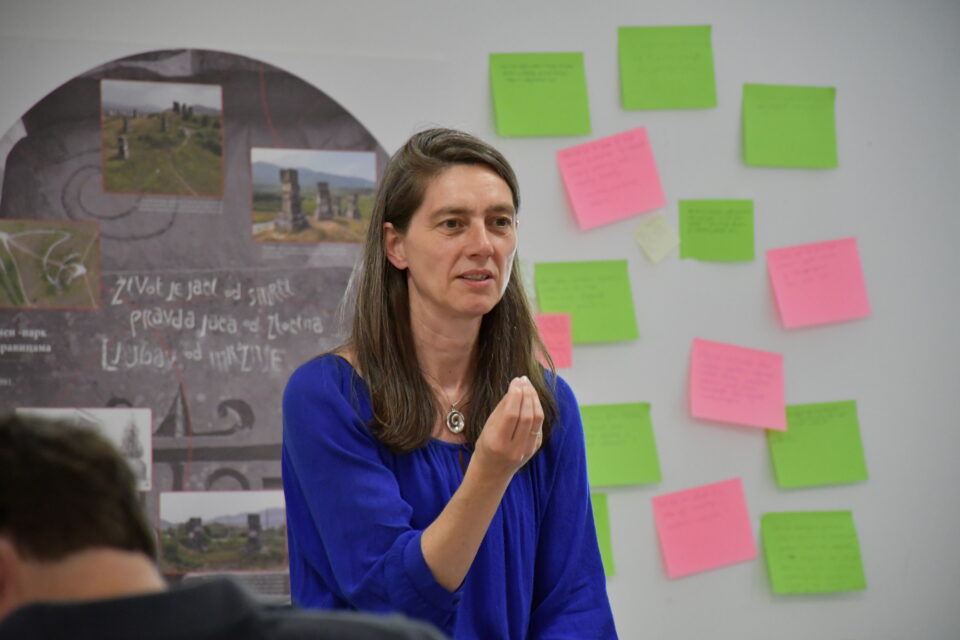
The Bosnian context panel examined the difficult realities of the education system in post-war Bosnia, building peace with youth and beyond, as each panelist also spoke to how they navigate these challenges. Some collaborative projects shared included photography initiatives such as ‘The Love Tales: Imaging Peace,’ which displayed photographs of inter-ethnic couples in a divided society, an exhibit put together by the Post-Conflict Research Center (PCRC) in partnership with Tiffany Fairey.
Đuldina Kurtović, a professor of philosophy and aesthetics, discussed methods she has developed to foster imagination, creativity, curiosity, and critical thinking skills in students. The panel addressed regional efforts, including art initiatives such as ProPeace Western Balkans and the North Macedonian film ‘1700,’ as well as other initiatives that the Sarajevo-based office of ProPeace and the PCRC partner in, such as the Holocaust & Peace Education Curriculum, which incorporates creative approaches to peace education for youth. The House of Good Tones, a multi-ethnic musical project based in Srebrenica, was also highlighted, and participants expressed interest in other initiatives across the country. Nick Pantelic presented on his experiences with local peacebuilding through education and the arts during his time with PCRC, including Mirmagazine, memorialization, Balkan Diskurs, and other initiatives.
Beyond Sarajevo: Continuing the Conversation
The PCRC organized a visit for the group to the War Childhood Museum, a rare space that showcases the impact of violence on children, a sometimes overlooked experience of war, positioning them as survivors and exemplifying resilience through creative but still emotionally moving displays. One participant, Larissa Fuhrmann, shared from her experience at the museum,
“For me, working as a peace and conflict researcher means engaging with war most days of the week. I am trying to understand why it started and to analyze practices that resist it. The museum gave me a different perspective, zooming in on what is memorable to a child in war. The small yellow soldier that was found in a burned-down house and kept for years after as the “survivor” is something I will think of for a while.’’
The participants, as well as the PCRC, will continue engaging in creative practice amid the daily realities of the often long and difficult work of building peace and challenge themselves to remain open to curiosity and a “different perspective,” as Larissa commented. We are happy to announce that on June 9th, the conversation will continue through the PEACE Webinar Series, dedicated to the role of artistic practices in peacebuilding and understanding local peace in different contexts. Velma Saric, President and Founder of the PCRC, will moderate a panel discussion, and panelists will include Cindy Horst and Ilaria Tucci . The discussion will address how art can contribute to strengthening communities, understanding diverse experiences, and creating spaces for peace. During the webinar, Tiffany Fairey will present more of these concepts of capturing peace and Peace Photography.
More information can be found here:https://lnkd.in/d4i3jh5F.
Written by: Adysen Moylan, PCRC’s Fellow