


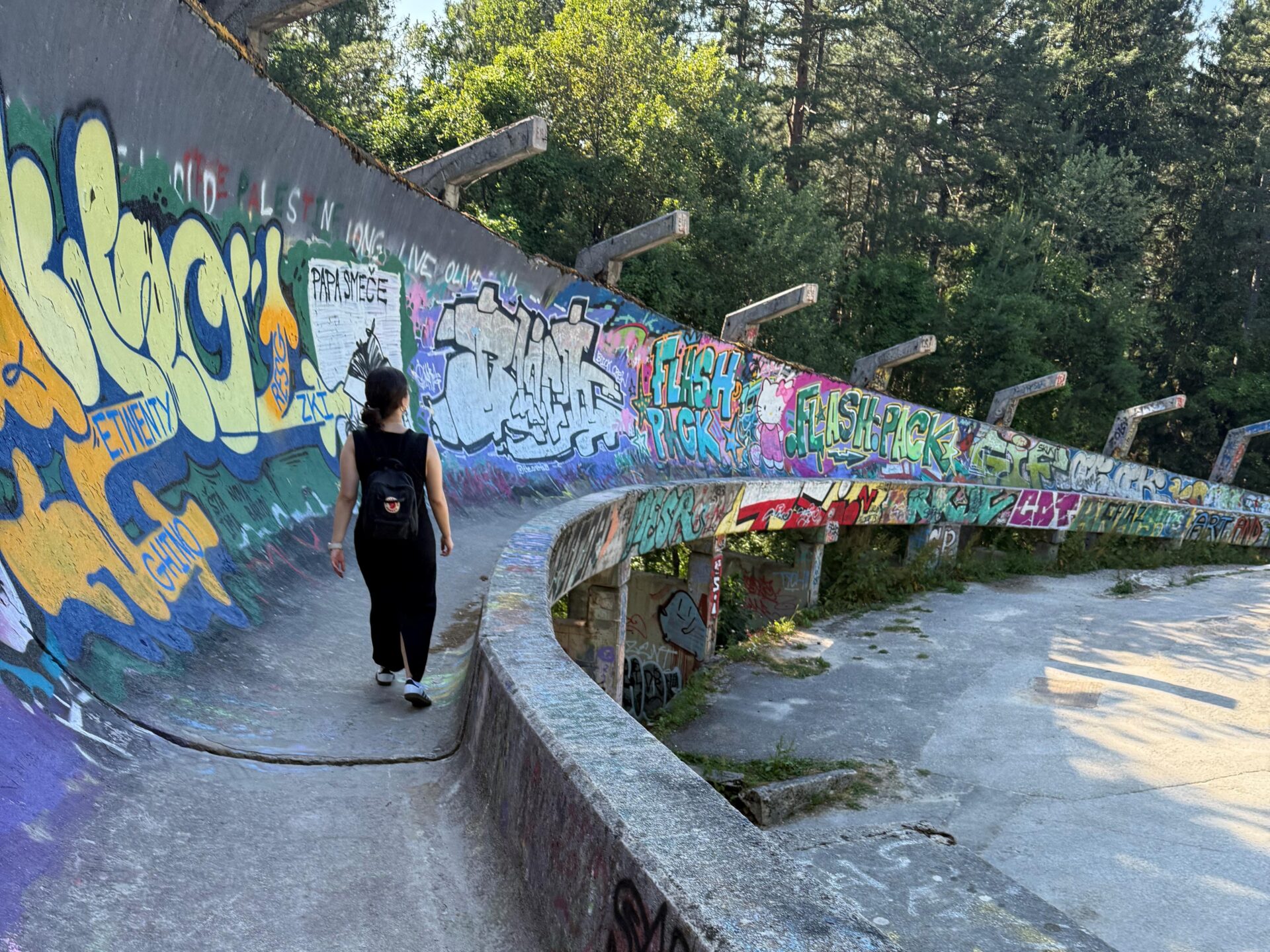
“What brings a young Mexican woman to this part of the world?” Two women and a girl asked me this, with gentle curiosity, as I stood in line to board a flight from Greece to Sarajevo. They had noticed my Mexican passport and could not resist asking. I did not have a polished answer. I told them, honestly, that I had long wanted to visit because I found their culture and history so rich and diverse. Their warmth, our small talk, and the ease of that exchange set the tone for the days to come, a reminder that it is encounters, not itineraries, that often shape the meaning of a journey.
I should offer a disclaimer before going further. I am writing this a year later, in June 2026, looking back on a trip I took in June 2025. I write this with deep respect, and not as an attempt to romanticize Bosnia and Herzegovina, nor to “tell” its story. I am not an expert, and I do not intend to become one in these pages. What I do believe in is the power of storytelling and of sharing experiences, especially when it comes to memory and resilience. My trip to the Balkans was a personal decision, not a research or professional one. Precisely because of that, it added another layer to what I thought I knew about the country, and perhaps the most important layer of all: human understanding.
A little about me: I am a Mexican lawyer working in international dispute resolution. I first encountered Bosnia and Herzegovina through international law and literature, and I am a passionate student of both, as well as a lover of travel and of learning from other cultures. I came to know the Post-Conflict Research Center through an intern at my firm, Miriam, now a friend with shared interests in international law, who once gifted me a Srebrenica flower. PCRC’s mission resonated with me immediately, particularly its commitment to peace education as a tool for engaging younger generations and promoting intercultural understanding.
My knowledge of the country began in the classroom. It was in my Public International Law course at university that I first read the International Court of Justice’s judgment in the case concerning the Application of the Convention on the Prevention and Punishment of the Crime of Genocide (Bosnia and Herzegovina v. Serbia and Montenegro). I returned to it later as a competitor in the Jessup Moot Court Competition. It is a complex judgment, and at the time I read it the way a student does, as a problem to be understood. Only later would I realize how much there was to learn beyond what I had read on the page.
Alongside the law, I encountered a very different kind of account in literature: Safe Area Goražde by Joe Sacco and Postcards from the Grave by Emir Suljagić. Reading the ICJ judgment and reading these books were not at all the same experience. When we study caselaw from other jurisdictions, we tend to put on the lens of “international law,” trying to grasp the rules and the reasoning of the court. Sacco and Suljagić, by contrast, approach the war from an individual, day-to-day perspective, one as a journalist documenting what was happening in Goražde, the other as someone who lived through the genocide. That spectrum, the legal and the lived, was where my understanding of Bosnia and Herzegovina began, and where my journey would later challenge me.
Then came the other side of the coin: the trip itself. I want to be clear that I will not use names or share identifying details; every anecdote here is anonymized out of respect for the people I met. I traveled to the Balkans on vacation, without an academic or professional agenda. Yet, as someone trained in international law and inclined to listen when I travel, it was inevitable that I would learn and that I would let my experiences challenge what I thought I knew. Across two weeks in Bosnia, Croatia, and Greece, daily conversations and small encounters became my real education.
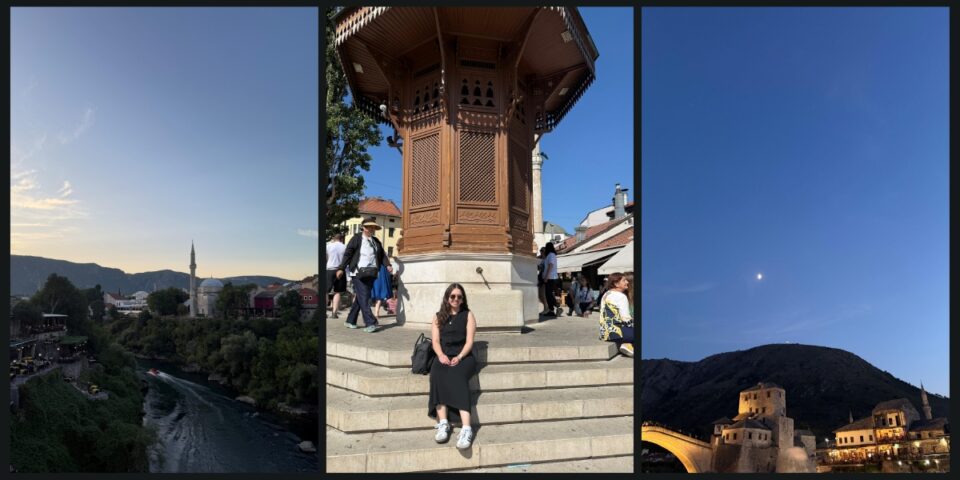
Some moments stay with me. “Telenovelas”, of all things, turned out to be unexpected bridges. Mexican and Latin American soap operas kept surfacing in casual conversation, a shared vocabulary of melodrama and morality that made us laugh and nod at the same beats; even our sense of humor felt familiar. I came to recognize something I know well from home: that Mexicans and Bosnians both tend to laugh in the face of sorrow, not to diminish it, but to carry it. I found myself sharing my own corner of the world too, a little about Mexico, our traditions, and the way we hold on to memory and family. More than once I heard a phrase that held both grief and hope in a single breath: “It was sad, but people, regardless of their ethnicity or religion, are the same.”
I also learned how tightly identity can still be bundled. In an Orthodox church in Tuzla, a kind woman asked if I was Orthodox; a friend clarified that I am Catholic. When I added that I am from Mexico, a flicker of surprise crossed her face, a small reminder of how closely nationality and religion can be tied together in people’s assumptions. Other moments were lighter and just as instructive (I did not know this existed): a misheard reference to a “Tuzla statute” led me to the Charter of Ban Kulin, a landmark medieval trade agreement between Bosnia and the Republic of Dubrovnik, a lesson in how stories travel and change across centuries. And there was the everyday hospitality, snacks passed hand to hand, shared songs, dances, belly laughs, and even a glimpse of a wedding, that taught me more than any guidebook could.
My work has taught me to read judgments and procedures closely. Reading once about the Dayton Accords, I once wondered whether that negotiation was really what we now call “mediation.” After visiting, the question felt less technical and far more human. Here, memory, responsibility, and dialogue aren’t abstractions; they’re part of daily life.
I am not an expert. But as someone who really likes international law, and given the state of the world today, I have come to believe that ordinary interactions, conversations, and travel can contribute to peaceful coexistence. My hope, in sharing this, is modest: to encourage other people, and other professionals, to rethink their own legal lens, especially when confronting matters as delicate and historic as genocide. In the end, what matters is acknowledging what happened and choosing to work with a vision of peace. Above all, it is about staying open, continuing to listen, and being willing to rethink what we thought we knew. Bosnia stayed with me, just as a woman I met there, wrote to me after I left: “How deeply you hid in my heart.”
Author: Sara Contreras
Sara Contreras Medrano is a Mexican lawyer and graduate of CIDE (Centro de Investigación y Docencia Económicas), with professional experience in international law, international arbitration and dispute resolution.