


Two years after interior ministers endorsed a revised regional roadmap, SEESAC brought civil society organisations to Budva to discuss a role the document itself says is missing
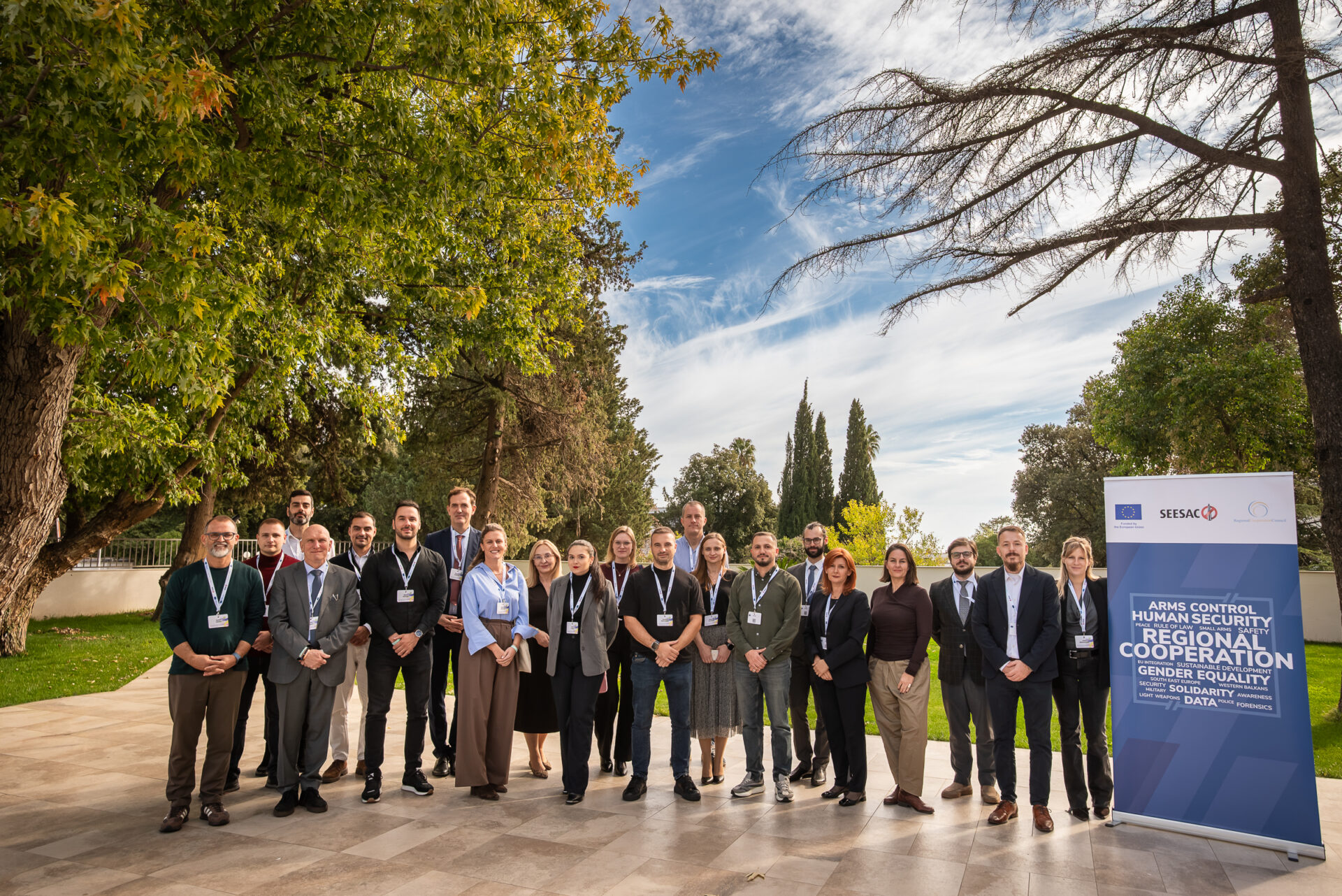
Post-Conflict Research Center (PCRC) took part in a regional workshop on a whole-of-society approach to small arms and light weapons (SALW) control in the western Balkans, held in Budva, Montenegro, on 29 and 30 October. The event was organised by SEESAC, the Belgrade-based clearinghouse run jointly by the UN Development Programme and the Regional Cooperation Council.
The venue was apt. In October 2024, the region’s interior ministers endorsed the revised Roadmap for a sustainable solution to the illegal possession, misuse and trafficking of SALW, which runs to 2030. The first version was adopted at a summit in London in July 2018. The current one has five goals and thirteen indicators, which the six jurisdictions report on twice a year.
The results so far are substantial. Between 2018 and 2025, authorities in the region received 313,851 firearms through voluntary surrender campaigns and destroyed more than 46,000 surplus and 23,000 confiscated firearms. But the trend has turned. Voluntary surrenders fell from 119,488 firearms in 2023 to 32,046 in 2024 and 19,079 in 2025. In the Balkan Barometer survey of 2023, 45 per cent of citizens said they felt threatened by illegal weapons in their neighbourhood. SEESAC’s Armed Violence Monitoring Platform recorded 17,792 firearms incidents in the region in the six years to 2025; 46 per cent of them were seizures.
An acknowledged gap
Almost all implementation so far has been institutional: governments, police, SEESAC and international organisations. The Roadmap says as much. It notes that civil society organisations are not fully integrated into arms control policy development, that women’s organisations are insufficiently included, and that community outreach has been sporadic. A final evaluation of the EU’s fifth Council Decision supporting SEESAC, published in June 2025, reached a similar conclusion from the other side: work with SALW commissions, police and border services is well established, but public-facing prevention, such as awareness, education and surrender campaigns, sits outside SEESAC’s core model.
The first day covered definitions, international and regional legal frameworks, alignment with EU law, improvised and converted weapons, and how the Roadmap is coordinated and monitored, including the role of national SALW commissions. The second day turned to armed violence trends, the factors driving demand for firearms, and the link between firearms, domestic violence and norms of masculinity. It ended with small-group work on how civil society can take a larger part in SALW control and what practical steps are available locally and regionally.
Where cooperation is possible
The Roadmap and the agenda point to several areas where civil society organisations have a clear entry point.
Data. The Roadmap calls for incident data disaggregated by sex and age by 2028. The monitoring platform already records sex, but age disaggregation is uneven. Independent researchers can analyse what exists and say plainly where it falls short.
Outreach. A regional awareness-raising task force, facilitated by SEESAC, already exists. With surrenders falling and legalisation of unregistered weapons down to single and double digits in some places, campaigns that reach people the institutions do not are an obvious need.
Media. The Roadmap sets 2025 to 2027 as the window for a better partnership with the media on reporting firearms misuse. Its own baseline says coverage tends to treat firearms benignly, as “gun culture” or “tradition”. Guidelines on reporting incidents are being developed.
Gender and demand. SEESAC presented recent research on what drives demand for firearms and on firearms in domestic violence. Women’s organisations and groups working with young men have direct experience to add to both.
Policy. A mid-term review of the Roadmap is due by 2027, and the national commissions hold regular coordination meetings. Both are places where civil society input can be offered.
Thirty years after the wars, the region has built a working arms control system. Whether it can also build public trust in it is the question the Budva workshop put to civil society.
Author: Nedim Jahić, PCRC